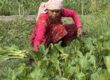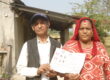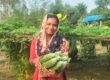
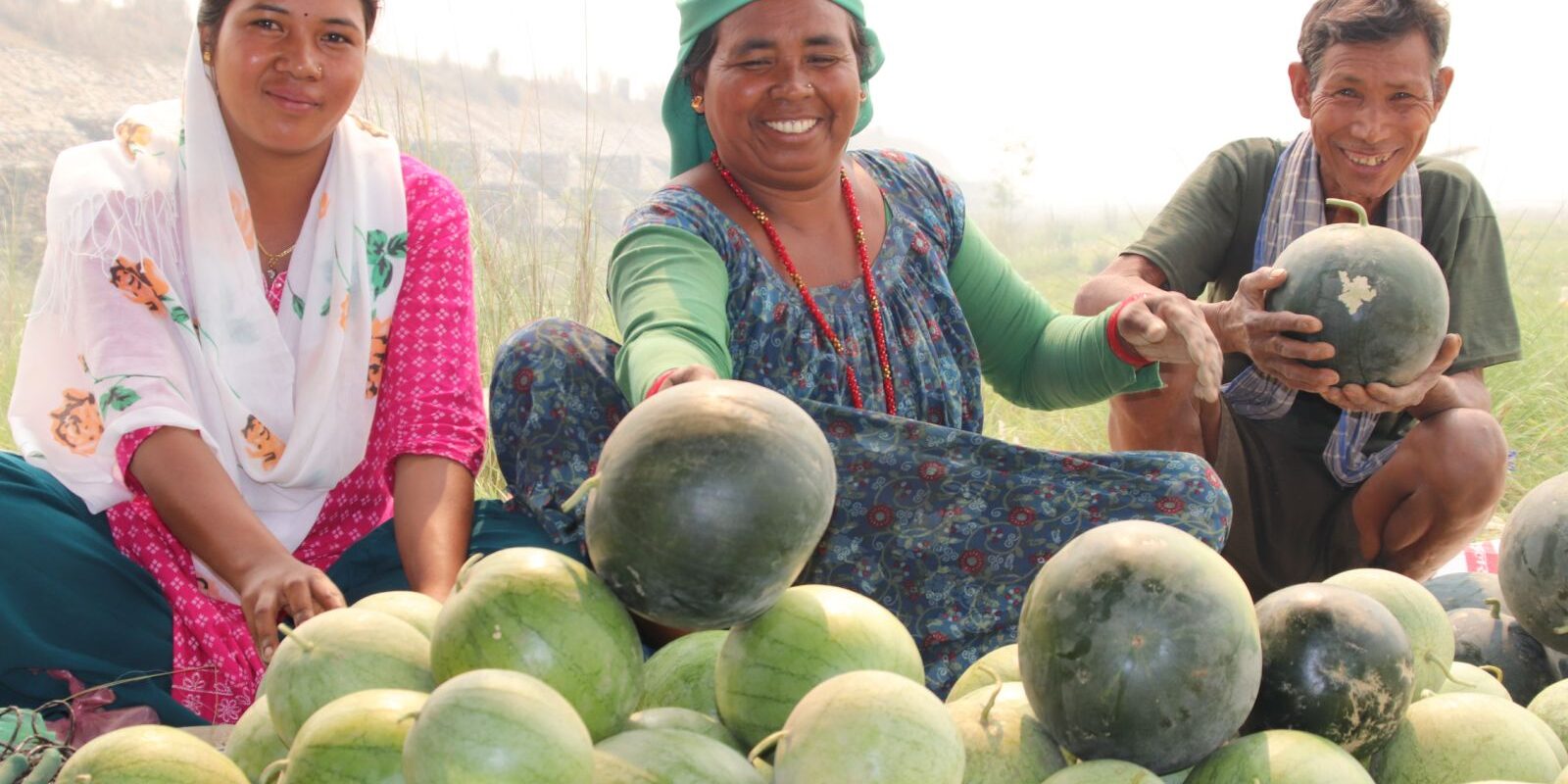
What began as an experiment has become something to celebrate for members of the Shiva Mandir Community Farmers’ Group. This season, eight farmers, all landless, smallholders transformed 1.33 hectares
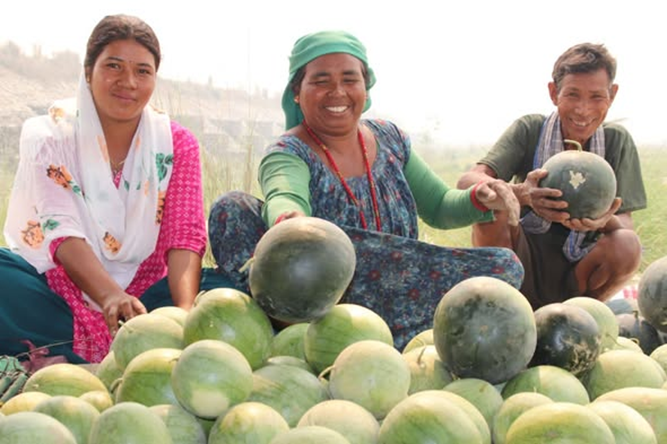
From riverbed to market: happy famers with the watermelon harvest
of neglected riverbed in Bhagwanpur-6, Rapti Rural Municipality into a thriving watermelon plot. With technical support and input from the Community Self Reliance Centre’s Climate Smart Agriculture program, they planted three varieties- Saraswati, Laxmi-747, and Krisha, and followed expert guidance on composting and nutrient management, including zinc sulphate for healthy fruit development.
Their hard work paid off: the group harvested 8,366 kg of watermelon and sold nearly 75% of the crop, earning over NPR 500,000. For farmers who once grew only cereals and peanuts and who viewed riverbanks as unusable land, this success feels nothing short of miraculous. As one farmer, Som Bahadur Chaudhary, reflected, “We invested time and sweat with the hope of creating a good income now this land gives us independence.”
Beyond the income, this initiative has also sparked confidence and hope. What was once dry grassland where a river flowed is now a model of sustainable, climate‑smart cultivation and a tangible step toward economic resilience for landless families. This harvest marks not just financial gain but the beginning of lasting change for the community.
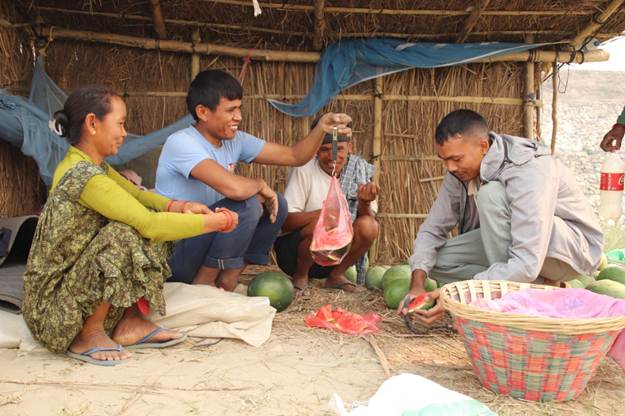
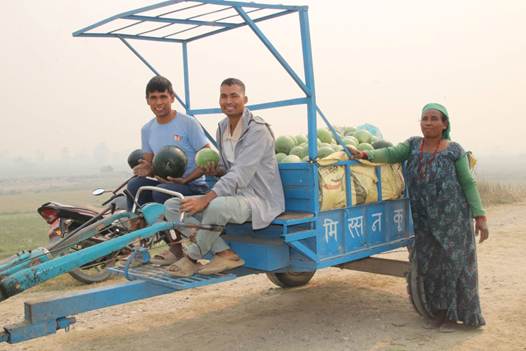
Watermelon ready to be taken to the market
The farming initiative in the marginalized riverbed area was undertaken collectively by the group. As the produce is still being sold, the income generated will be shared in two ways: 50 percent will be distributed equally among all individuals, while the remaining 50 percent will be mobilized within the group of eight farmers according to their needs, with a portion allocated on an interest‑based arrangement.
The total investment made in the watermelon farming initiative amounted to NPR 161,040. This included expenses such as NPR 93,540 for seeds, NPR 16,000 for fertilizer and biopesticides, NPR 6,000 for bamboo fencing, NPR 7,500 for land levelling, NPR 35,000 for marketing, and NPR 3,000 for irrigation. Together, these costs reflect the careful planning and resource allocation that enabled the farmers to transform the riverbed land into productive fields.
The program has been implemented in two other communities, Baghkholi Land Right Farmer Group, Lamahi-8 and Basantapur Land Right Farmer Group, Rajpur-3, in an area of 2 and 1 hectares respectively. The watermelon at Basantapur will be ready to harvest within the first week of May, while a few farmers have started to sell the produce in Baghkholi, Lamahi-8.
Guliya Chaudhary, Chairperson, Shiv Mandir Samudayik Krishak Samuha, “We had never even imagined that we would be able to grow watermelons on this land. Today, as we harvest and sell watermelons and earn a good income, we are very happy. Now, next year we will cultivate watermelons again and expand the cultivation area. It seems that we can earn a good income from watermelons within just 3–4 months.”
The Climate Smart Agriculture ( CSA) Program is currently running under the program‘ A safety net of innovative land tenure solutions for near landless and sharecroppers and for a greener rural Nepal L4ACT which is currently being implemented by UN-Habitat with funding from Ministry of Agriculture, Food and Rural Affairs (MAFRA) of Republic of Korea and in collaboration with Ministry of Land Management, Cooperatives and Poverty Alleviation (MoLMCPA) Government of Nepal is under implementation in Deukhuri Valley of Dang district and supported by Community Self Reliance Centre (CSRC), Good Neighbors International (GNI) Nepal, and South Korea based organizations, Korea Rural Economic Institute (KREI) and Korea Land and Geospatial Informatix Corporation (LX).
Written by: Aparajita Gautam & Anusha Acharya
Photos: Sagar Sharma