Program Name: Rights-based and Agroecological Initiatives for Sustainability and Equity in Peasant Communities (RAISE II–Nepal)
Implementing Organization: Community Self Reliance Centre (CSRC)
Funding Partner: Fastenaktion, Switzerland
Collaborating/Partner Organizations: Nepal Little Flower Society Nepal, FEDO, Sahakarmi Samaj, Dignity Initiative, District Land Rights Forum Rasuwa, and local governments in the working areas
Program Duration: October 1, 2026 – December 31, 2027 (15 months)
Total Budget: NPR 13,683,628 (Thirteen million six hundred eighty-three thousand six hundred twenty-eight rupees only)
1. Program Introduction
The RAISE II–Nepal program is implemented by CSRC. Its main objective is to support landless and marginalized communities, as well as small farmers, in securing land rights while promoting sustainable and environmentally friendly agricultural systems.
In Nepal, landless Dalits, sukumbasi, informal settlers, and marginalized farmers have long faced challenges regarding land ownership, access to land, and secure livelihoods. Communities that use land without legal ownership, farmers with minimal land, and those dependent on traditional farming systems suffer from insecurity of land rights and livelihood challenges. This has negatively impacted on their agricultural production, food security, and socio-economic conditions.
In this context, the program aims to raise awareness and empower landless and marginalized farming communities about land and farmers’ rights, strengthen the capacity of stakeholders from local to national levels, and reinforce policy advocacy related to land and farmers’ rights. It will also document and exchange practices and models of land access and ownership, linking them to sustainable agriculture systems.
2. Program Objectives
- Empower landless farmers to claim and exercise their rights as guaranteed by the UN Declaration on the Rights of Peasants (UNDROP), Nepal’s Constitution, and existing laws.
- Enhance knowledge, engagement, and accountability of local, provincial, and national stakeholders in implementing land and farmers’ rights.
- Strengthen policy advocacy for the formulation, amendment, and implementation of laws, policies, and plans related to land and farmers’ rights, ensuring meaningful participation of landless farmers.
3. Program Areas
The program will be implemented in five local governments across Karnali and Bagmati provinces:
| Province | District | Local Government |
| Karnali | Dolpa | Thulibheri Municipality |
| Karnali | Kalikot | Sanni Triveni Rural Municipality |
| Karnali | Surkhet | Chaukune Rural Municipality |
| Bagmati | Makwanpur | Raksirang Rural Municipality |
| Bagmati | Rasuwa | Kalika Rural Municipality |
4. Target Communities
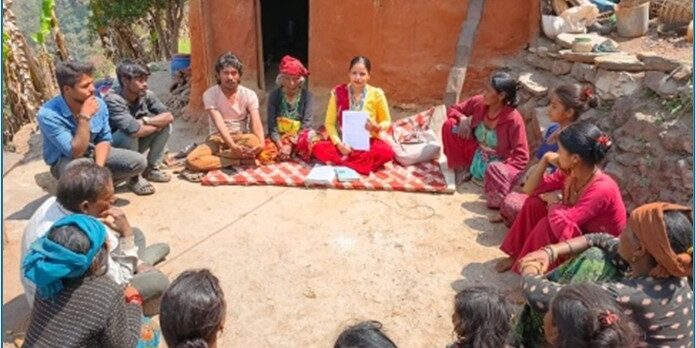
The program primarily targets landless Dalits, squatters, informal settlers, marginalized farmers, activists, civil society organizations, and local stakeholders working in the field of land rights and livelihoods.
It is expected to directly benefit around 500–600 individuals. Additionally, it will contribute to capacity building of organizations, community leaders, and local government representatives engaged in land rights work.
5. Key Activities
- Review of existing land acts, rules, and directives with participation of landless farmers.
- Workshops between community representatives and policymakers to share findings of land rights studies.
- Documentation of community practices and experiences related to land access.
- Study on corporate and commercial agriculture and its impact on landless and farming communities.
- Mapping of shifting cultivation farmers in Raksirang and study of soil traditions in Kalikot.
- Training for partner organization staff and community leaders on land and farmers’ rights.
- Research, resource material development, publication, and dissemination on land rights and UNDROP.
- Multi-stakeholder dialogues and policy advocacy at local, provincial, and federal levels.
- Preparation of concept papers and policy recommendations addressing landless farmers’ issues.
- Facilitation in drafting and implementing local land laws and land lease directives.
- Support to local governments in identifying, verifying, and documenting landless families.
6. Expected Outcomes and Impact
- Increased knowledge, awareness, and capacity among landless and marginalized farming communities to claim their rights.
- Enhanced capacity and accountability of local governments and stakeholders, facilitating identification, verification, documentation, and registration processes for landless families.
- Strengthened policy debates and advocacy, contributing to farmer-friendly laws, policies, and plans with meaningful community participation.
- Improved livelihoods and food security of marginalized farming communities through exchange of successful land access practices and promotion of sustainable, eco-friendly agriculture.